Adding AI to an existing product in 2026: $12,000 to $210,000, by scope

TL;DR Adding AI to an existing product costs between $12,000 and $210,000 at US agency rates in 2026. A feature that drafts or summarises with a hosted model sits at the bottom, an assistant that answers from your own data in the middle, and an agent that takes actions at the top. The model is honestly the cheapest part, and the cost is in the data, the interface, the evaluation and the guardrails around it.
- A feature built on a hosted model takes about 120 to 300 hours, so roughly $12,000 to $45,000 at US agency rates.
- An assistant that answers from your own data takes about 300 to 700 hours, so roughly $30,000 to $105,000.
- An agent that takes actions with guardrails takes about 700 to 1,400 hours, so roughly $70,000 to $210,000.
- Running the model is a monthly cost on top of the build, and it should be budgeted before launch.
- Start with one job a person does by hand today, and score the model against real examples before it goes live.
In this article
Adding AI to a product you already have costs between $12,000 and $210,000 at US agency rates in 2026, and the range is that wide because "AI" covers three very different jobs. A feature that drafts or summarises with a hosted model sits at the bottom, an assistant that answers from your own data sits in the middle, and an agent that takes actions on its own sits at the top.
I run the engineering at Axtra Studios, and honestly the model is the cheapest part of all three. The cost is in the product around it, so the data it sees, the guardrails, the screen where a person checks its work and knowing whether it actually worked, and this guide goes through each of those.
AI featureA part of your product where a model does a job a person would otherwise do by hand, like drafting, summarising, answering from your documents or carrying out a task, with the result checked before anyone relies on it.
What adding AI costs in 2026
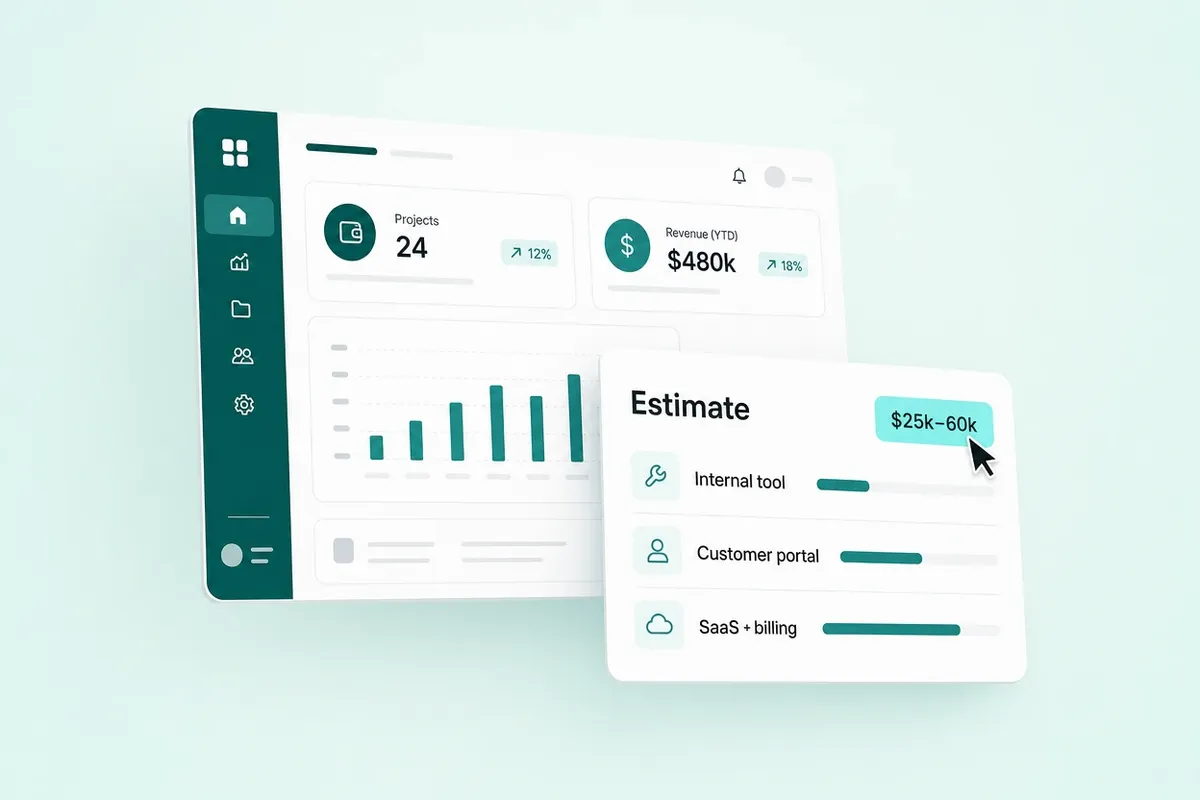
The hours below come from the AI work I have scoped and shipped with the team here, and the dollar column prices those same hours at US agency rates, which Clutch puts at $100 to $149 an hour for web development.
| What the AI does | Time | Hours | At US agency rates |
|---|---|---|---|
| A feature on a hosted model: drafting, summarising or sorting | 2 to 4 weeks | 120 to 300 | $12,000 to $45,000 |
| An assistant over your own data, with sources and an evaluation set | 4 to 8 weeks | 300 to 700 | $30,000 to $105,000 |
| An agent that takes actions, with guardrails and human sign-off | 8 to 12 weeks or more | 700 to 1,400 | $70,000 to $210,000 |
What adding AI to an existing product costs in the US, 2026 · Source: Time and hours from Axtra Studios projects. Rates from Clutch's web development pricing guide (US agencies, $100 to $149 an hour; updated September 21, 2026). Model usage is a separate monthly cost.
On top of the build there is a monthly cost for the model itself, which grows with how much people use the feature. We budget that up front with you, cache what we can and route simple requests to smaller models, so the running cost is a number you agreed to and not a surprise on the first invoice.
Start with one job
The AI features that work are the ones that do a real job a person would otherwise do by hand. So before anything else, I would ask what that job is in your product, who does it today and how you would know the model did it well.
Boomerangme's Richie is a good example of one job done properly. A business owner pastes a Google Business Profile link and Richie drafts the loyalty card, the rules and the first messages, so the owner starts from a draft to check instead of a blank page. One feature like that is basically always a better start than an AI layer across the whole product.
The parts that cost more than the model
The first is the data. An assistant that answers from your documents needs retrieval over an index you own, with the sources attached to every answer, and in my experience getting your data into a shape a model can use is usually the biggest single task in the middle row of the table.
The second is the interface. Someone has to see what the model suggested, correct it when it is wrong and know when it is unsure, and designing that is the same UX/UI design work as any other screen, just with a less predictable input.
The third is evaluation, which is the part most teams skip. We write an evaluation set with you from real examples, score every release against it and track accuracy, cost and speed on one dashboard, so nothing goes live on a hunch.
Guardrails for anything that acts
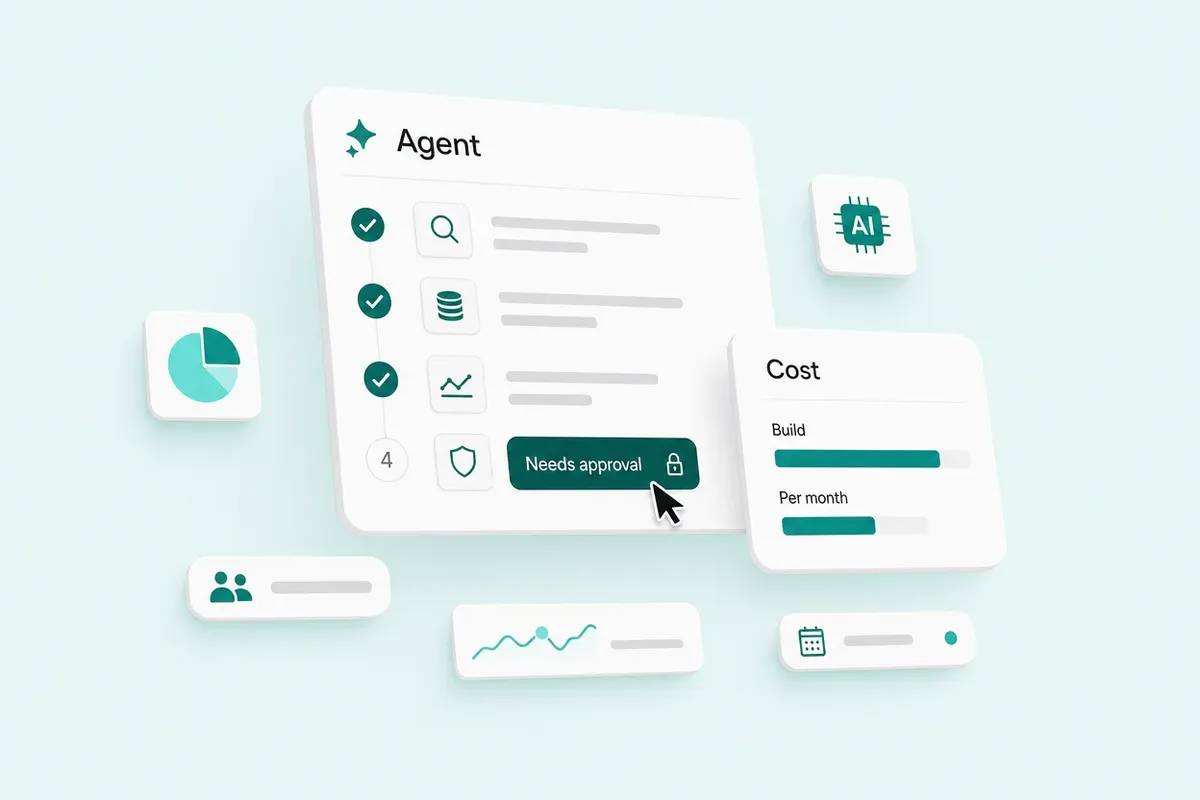
An agent that only reads and suggests is one thing, and an agent that takes actions is another, so this is where the top row of the table comes from. Omniya prepares gift orders on retailers' own websites, and it stops at the payment step every time, because seven checks run in code before anything happens and the browser driver refuses to type into a payment field whatever the model decides.
That is the pattern I would use for any agent that touches money, customers or records, and the same goes for a team of agents, like the six specialised ones that share one workspace in Elixo. The hard limits live in code where a model cannot talk its way past them, and a person signs off wherever the stakes need one.
When an off-the-shelf model is not enough
Most products never need a model of their own, and a hosted model with good retrieval and good evaluation does the job. Now and then the job is specialised enough that it does, like Velos Bio, which is a physics-guided model that turns ordinary microscope images into calibrated measurements, with its output scored against ground truth. That kind of work sits at the very top of the range and takes longer than the table shows.
Your data and your choice of model
Your data stays in your accounts. Retrieval runs against indexes you own, prompts carry only what the task needs, and where your policy asks for it we choose the provider or a model hosted in your own cloud.
We use OpenAI and Anthropic models by default, chosen per task, and we build so the model can be swapped later. Models change every few months, and the retrieval, the guardrails and the evaluations are the parts that last.
How to get a number for yours
If you know the one job you want AI to do, a short call is enough to tell you which row you are in. We can look at your product, your data and that job together and send you a written scope priced in milestones.
If the AI feature is part of a bigger build, our guides to web app cost in 2026 and MVP cost and timeline cover the rest, and our AI expertise page has more of the work behind this guide. Everything here follows our editorial policy.