AI chatbot and agent cost in 2026: $12,000 to $210,000, plus running costs

TL;DR A custom AI chatbot or AI agent built by a US agency in 2026 costs $12,000 to $210,000 to build, and about $10 to $55,000 a month to run, depending on users and model. A chatbot over your own data usually lands at $30,000 to $105,000, and an agent that takes actions at $70,000 to $210,000. Below a few thousand conversations a month, an off-the-shelf bot like Intercom's Fin is honestly the cheaper choice.
- An AI feature on a hosted model takes about 120 to 300 hours, so roughly $12,000 to $45,000 at US agency rates.
- A chatbot or assistant over your own data takes about 300 to 700 hours, so roughly $30,000 to $105,000.
- An agent that takes actions with guardrails takes about 700 to 1,400 hours, so roughly $70,000 to $210,000.
- Running a support chatbot for 1,000 active users costs about $100 to $260 a month in model fees, and an agent about $2,700 to $5,400.
- Against Intercom's Fin at $0.99 per outcome, a $30,000 custom bot pays back in about a year at 1,000 users and in under two months at 10,000.
In this article
- What an AI chatbot or agent costs to build in 2026
- Do you need a chatbot, an assistant or an agent?
- What it costs to run every month
- When buying an off-the-shelf bot is the better deal
- Where the build hours actually go
- How long it takes
- What makes AI projects cost more than planned
- How we know it works before launch
- Guardrails for an agent that acts
- Where your data goes
- What to prepare before you ask for a quote
- When we are not the right fit
- How to get a number for yours
A custom AI chatbot or AI agent built by a US agency in 2026 costs between $12,000 and $210,000 to build, and then somewhere between about $10 and $55,000 a month to run, depending on how many people use it and which model it runs on.
A simple feature on a hosted model sits at the bottom of that, an assistant that answers from your own data sits in the middle, and an agent that takes actions on its own sits at the top, while setting up an off-the-shelf bot instead costs a few thousand dollars.
Most cost guides stop at the build number, and honestly the monthly bill is the part founders ask me about most once a project is live. So this guide gives both, with the running cost worked out from the model prices OpenAI and Anthropic publish today, and the point where buying an off-the-shelf bot stops being the cheaper option.
AI agentSoftware that uses a language model to decide and take steps toward a goal, like looking something up, filling in a form or updating a record, instead of only answering a question. A chatbot answers, and an agent acts.
What an AI chatbot or agent costs to build in 2026
The hours below come from the AI work I have scoped and shipped with the team at Axtra Studios, and the dollar column is those same hours priced at what US agencies charge, which Clutch puts at $100 to $149 an hour for web development. Every row includes the evaluation work, because an AI feature nobody has tested is basically a demo.
| What you get | Time | Hours | At US agency rates |
|---|---|---|---|
| An off-the-shelf chatbot set up on your help center: content, rules and handoff to your team | 1 to 3 weeks | 40 to 120 | $4,000 to $18,000, plus the platform's fees |
| An AI feature on a hosted model: drafting, summarizing or sorting inside your product | 2 to 4 weeks | 120 to 300 | $12,000 to $45,000 |
| A chatbot or assistant over your own data, with sources and an evaluation set | 4 to 8 weeks | 300 to 700 | $30,000 to $105,000 |
| An agent that takes actions, with guardrails and human sign-off | 8 to 12 weeks or more | 700 to 1,400 | $70,000 to $210,000 |
What an AI chatbot or agent costs to build in the US, 2026 · Source: Time and hours from Axtra Studios projects. Rates from Clutch's web development pricing guide (US agencies, $100 to $149 an hour). Checked October 4, 2026. Model fees are separate and shown below.
The first row is the cheapest because a hosted bot like Intercom's Fin brings the model, the interface and the handoff to your team with it, so the work is mostly your content and your rules. The other three are built for you, which is where the hours go up, and where you start owning the thing instead of renting it.
Do you need a chatbot, an assistant or an agent?
A chatbot answers questions. If the answers are already written somewhere, in a help center, in your docs or in your policies, then a chatbot on top of that content is usually all you need, and it is the cheapest thing on this page to run.
An assistant does a job inside your product. It drafts, summarizes or sorts something a person would otherwise do by hand, and the person checks the result. Boomerangme's Richie is a good example, since a business owner pastes a Google Business Profile link and Richie drafts the loyalty card, the rules and the first messages for the owner to review.
An agent takes actions. It clicks, fills in, sends or changes something in a real system, often across several steps, and that is why it costs the most to build and to run. Omniya is a good example, since it prepares gift orders on retailers' own websites, and Elixo runs six specialized marketing agents in one workspace.
The honest test is to ask what goes wrong when the AI is wrong. If the answer is "a customer reads a bad answer and asks again", a chatbot is fine. If it is "an order goes out, money moves or a record changes", you need an agent with guardrails, and that is a different budget.
What it costs to run every month
This is the part most guides leave out, so I worked it out from the prices on the OpenAI and Anthropic pricing pages as of October 4, 2026. The model bill depends on three things, which are how many people use it, how much text goes in and out of the model each time, and which model you pick.
For a support chatbot over your own documents, I assumed each conversation runs six back-and-forth turns, with about 4,000 tokens going into the model per turn (the instructions, the retrieved passages and the conversation so far) and about 300 tokens coming out, and that each active user has four conversations a month.
| Model | 100 active users | 1,000 active users | 10,000 active users |
|---|---|---|---|
| OpenAI GPT-5.4-mini | about $10 | about $104 | about $1,044 |
| Anthropic Claude Haiku 4.5 | about $13 | about $132 | about $1,320 |
| Anthropic Claude Sonnet 5.5 | about $26 | about $264 | about $2,640 |
Monthly model fees for a support chatbot over your own documents · Source: Assumes 4 conversations per user a month, 6 turns each, about 4,000 tokens in and 300 out per turn (24,000 in and 1,800 out per conversation), no caching. Prices from the OpenAI and Anthropic pricing pages, October 4, 2026.
For an agent, the numbers jump because one task is several model calls in a row. I assumed eight calls per task, with about 6,000 tokens in and 500 out per call, and 20 tasks per active user a month.
| Model | 100 active users | 1,000 active users | 10,000 active users |
|---|---|---|---|
| Anthropic Claude Sonnet 5.5 | about $272 | about $2,720 | about $27,200 |
| OpenAI GPT-5.6-Terra | about $288 | about $2,880 | about $28,800 |
| Anthropic Claude Opus 5.5 | about $544 | about $5,440 | about $54,400 |
Monthly model fees for an agent that carries out tasks · Source: Assumes 20 tasks per user a month, 8 model calls per task, about 6,000 tokens in and 500 out per call (48,000 in and 4,000 out per task), no caching. Prices from the OpenAI and Anthropic pricing pages, October 4, 2026.
Two things bring these numbers down a lot. The first is prompt caching, where the part of the input that repeats every time (the instructions and the tool definitions) is billed at a fraction of the normal price. If 70% of the agent's input is cached on Sonnet 5.5, the task drops from about $0.14 to about $0.08, so the 1,000-user month goes from about $2,720 to about $1,510.
The second is routing, so the simple requests go to a small model and only the hard ones reach the big one. Embeddings, which turn your documents into something searchable, are almost free in comparison, since indexing 10,000 pages of about 1,000 tokens each costs around $0.20 once with OpenAI's small embedding model.
On top of the model bill there is hosting, the database, logging and the cost of running your evaluation set before each release, which are usually small next to the model at any real volume. We budget all of it with you up front, so the running cost is a number you agreed to and not a surprise on the first invoice.
When buying an off-the-shelf bot is the better deal
If your chatbot only answers questions from your help center, buying is often the right call. Intercom's Fin is priced from $0.99 per outcome, and a custom chatbot on Haiku 4.5 costs about $0.03 per conversation in model fees, so the real question is how many conversations you have and how long it takes the build to pay for itself.
Say a bot resolves 60% of conversations. At 1,000 active users that is about 2,400 outcomes a month, roughly $2,380 on Fin against about $130 of model fees on a custom build, so a $30,000 build pays back in a bit over a year. At 10,000 users the gap is about $22,400 a month, and the same build pays back in under two months.
Below a few thousand conversations a month, I would honestly start with an off-the-shelf bot and spend the money on your content instead. The case for building gets strong when the volume is high, when the bot has to do things inside your own product, or when the answers depend on data a hosted bot cannot reach.
Where the build hours actually go
The model itself takes almost none of the hours. The first big piece is the data, so getting your documents, tickets or records into a shape a model can use, with retrieval that brings back the right passage and shows its source, and in my experience that is usually the largest single task in the middle row.
Then there is the interface. Someone has to see what the AI suggested, correct it when it is wrong and know when it is unsure, and designing that is the same UX/UI design work as any other screen, just with a less predictable input.
The integrations come next, because an assistant or agent is only useful if it can read from and write to the systems you already use, and every one of those has its own rules and its own ways of failing. And then there is the work around launch, so logging, monitoring, cost alerts and a way for your team to see every conversation.
How long it takes
A feature on a hosted model, like drafting replies or summarizing a long record, usually takes two to four weeks, because most of the work is the interface around it and the evaluation set. An assistant over your own data usually takes four to eight weeks, and most of that goes on getting the data into shape and making the retrieval reliable.
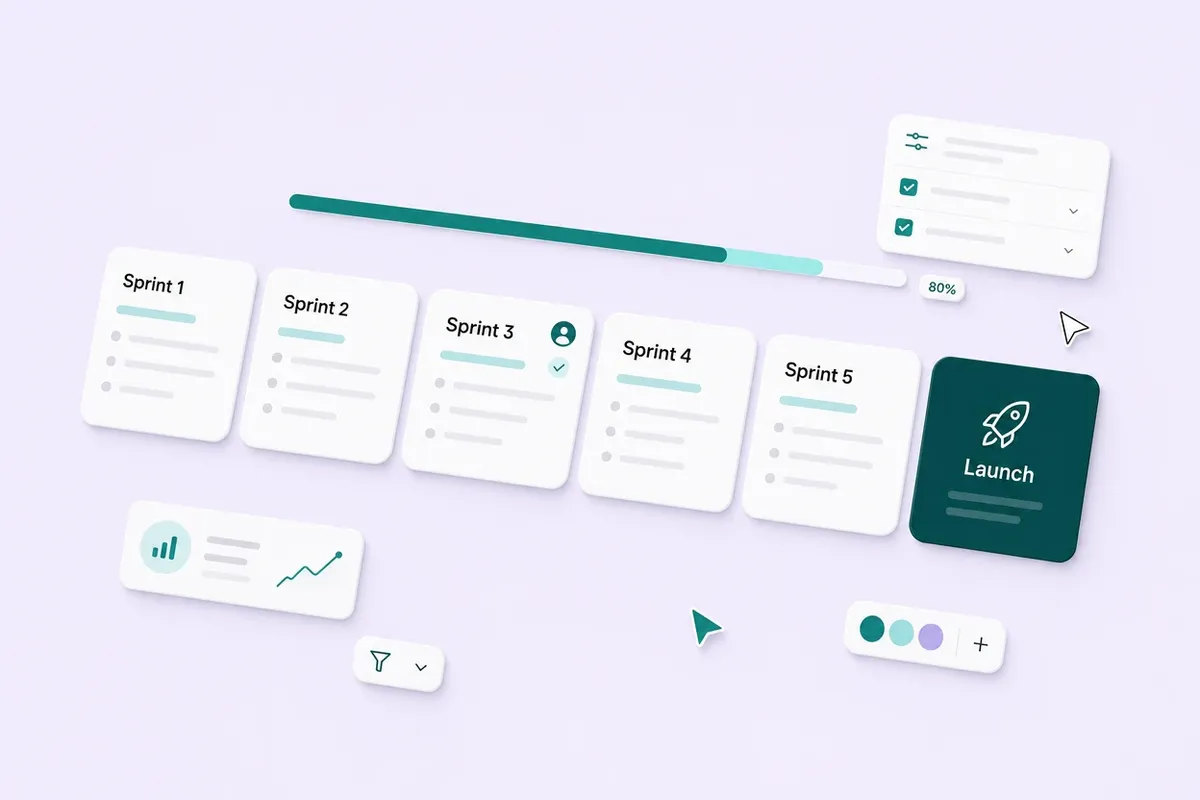
An agent that takes actions takes eight to twelve weeks or more, since every system it touches needs its own integration, its own checks and its own failure handling. We work in two-week sprints with a review at the end of each one, so you are using a working version well before the end, and you can stop at the assistant if that turns out to be enough.
What makes AI projects cost more than planned
The most expensive mistake I see is starting with an AI layer across the whole product instead of one job. It spreads the budget across ten half-finished features, and none of them is good enough to keep, so honestly one feature done properly is almost always the better first spend.
The second is skipping the evaluation set. Without one, every change to a prompt or a model is a guess, and the team ends up testing by hand before every release, which costs more over a year than building the set in the first place.
The third is picking the biggest model for everything. The largest models cost anywhere from four to twenty times what the small ones do per token, and most requests in a real product are simple enough for the small one, so routing the easy work to a small model is usually the biggest saving on the monthly bill.
And the fourth is forgetting the running cost until the first invoice. A feature that costs a few cents a conversation looks free in a demo, and it is still a real line in the budget at ten thousand users, which is why we put the monthly estimate next to the build cost from the first proposal.
How we know it works before launch
The part most teams skip is evaluation. We write an evaluation set with you from real examples of the job, score every release against it and track accuracy, cost and speed on one dashboard, so nothing goes live on a hunch.
You can start one today without us. Our evaluation set template is a plain spreadsheet with a column for the question, the answer you would accept, what the answer must never say and how to judge it, and filling in 50 real rows of it will tell you more about your AI feature than any demo.
For something specialized the evaluation goes further. Velos Bio is a physics-guided model that turns ordinary microscope images into calibrated measurements, with its output scored against ground truth, and that kind of work sits at the very top of the range.
Guardrails for an agent that acts
An agent that only suggests is one thing, and an agent that acts is another, so this is where the top row of the build table comes from. On Omniya the agent stops at the payment step every time, because seven checks run in code before anything happens and the browser driver refuses to type into a payment field whatever the model decides.
That is the pattern I would use for any AI agent that touches money, customers or records. The hard limits live in code where a model cannot talk its way past them, and a person signs off wherever the stakes really need one.
Where your data goes
Your data stays in your accounts. Retrieval runs against indexes you own, the prompts carry only what the task actually needs, and where your policy asks for it we choose a provider that does not train on your data, or a model hosted in your own cloud.
We use OpenAI and Anthropic models by default, chosen per task, and we build so the model can be swapped later. Models change every few months, and the retrieval, the guardrails and the evaluations are the parts that last, so they are the parts worth paying for.
What to prepare before you ask for a quote
You will get a much more accurate number if you can describe the one job you want the AI to do, who does it today and roughly how often. Twenty real examples of that job, with the answer you would accept for each, are worth more to an estimate than any feature list.
It also helps to know which systems it has to read from or write to, who checks its work, and what happens when it gets something wrong. And if you have a rough monthly volume, whether that is conversations, tickets or orders, we can put a real running cost next to the build cost instead of a guess.
When we are not the right fit
If you need a help-center bot this month and your volume is modest, an off-the-shelf tool is the better buy, and we will tell you that on the first call. The same goes for research that needs a large team training models from scratch, or for work that has to run inside a government cloud.
Where we fit is the middle of this page, so an assistant or agent inside a product you already have, or an AI web app where the model is the product, designed, built and evaluated by one team.
How to get a number for yours
The tables will tell you which row you are in, and a short call will tell you where in that row you land. We can look at your product, your data and the one job you want the AI to do, and send you a written scope priced in milestones with the monthly running cost next to it.
If the AI is going into something you already have, our guide to adding AI to an existing product goes deeper on that, and if it is part of a bigger build, the guides to web app cost in 2026 and MVP cost and timeline cover the rest. Our AI expertise page has more of the work behind this guide.
Prices in this guide come from the Anthropic, OpenAI and Intercom pricing pages and Clutch's web development pricing guide, all checked on October 4, 2026, and everything here follows our editorial policy.